Tutorials•14 min read
The Ultimate Guide to AI Image Describers
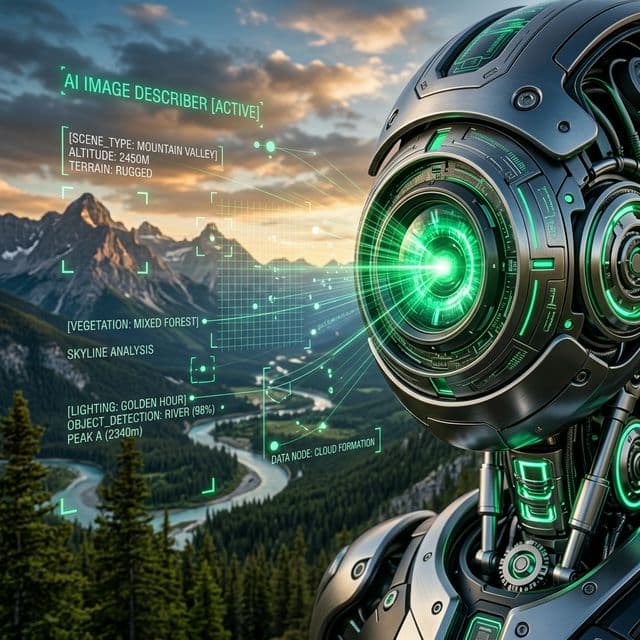
While most users think of an <a href="/tools/image-describer" class="text-blue-600 font-extrabold hover:underline">ai image describer</a> as a tool solely for generative AI reverse-engineering, its applications are vastly more expansive and economically critical. An intelligence that can accurately parse and explain visual data is fundamentally changing the entire fabric of web accessibility, automated SEO, and granular visual search.
What is an AI Picture Describer?
At its core, an image describer ai utilizes massive vision models—specifically GPT-4 Vision or specialized CLIP variants. Older image-recognition APIs merely outputted a list of nouns: "Dog, Tree, Sky." Modern systems are exponentially more advanced.
A true <a href="/tools/image-describer" class="text-blue-600 font-extrabold hover:underline">ai that describes images</a> identifies not just objects, but relationships, spatial mapping contexts, and emotional undertones within a photograph. It can deduce that a "sad woman looking out a rainy window" implies a melancholic atmosphere, rather than just listing "woman" and "window".
Beyond Prompting: Real-World Business Cases
1. Automated Web Accessibility (WCAG Compliance)
Millions of websites fail accessibility standards because developers leave image `alt` tags blank. Visually impaired users relying on screen readers are left navigating a broken web. Web developers use an ai that describes images to generate highly accurate, contextual `alt` tags at scale, instantly eliminating their WCAG legal risks.
2. Radical SEO Dominance via Google Images
Google's crawler cannot "see" images in the traditional sense. It reads the DOM. By using a localized <a href="/tools/image-describer" class="text-blue-600 font-extrabold hover:underline">image describer</a> to pipe thousands of hyper-descriptive strings into your image alt-tags, you force Google to index your visual assets across thousands of extremely specific long-tail keywords.
3. Competitor Aesthetic Breakdown
Design agencies frequently use an ai picture describer to dissect the color palettes, golden ratio configurations, and compositional rules of successful competitor marketing materials. By passing a viral advertisement into the describer, they extract the mathematical formula of its success.

The era of "blind" data is over. By integrating an ai image describer into your daily automation workflow, you violently bridge the gap between human visual perception and machine-readable databases.
E
Elena Rostova
Computer Vision Specialist