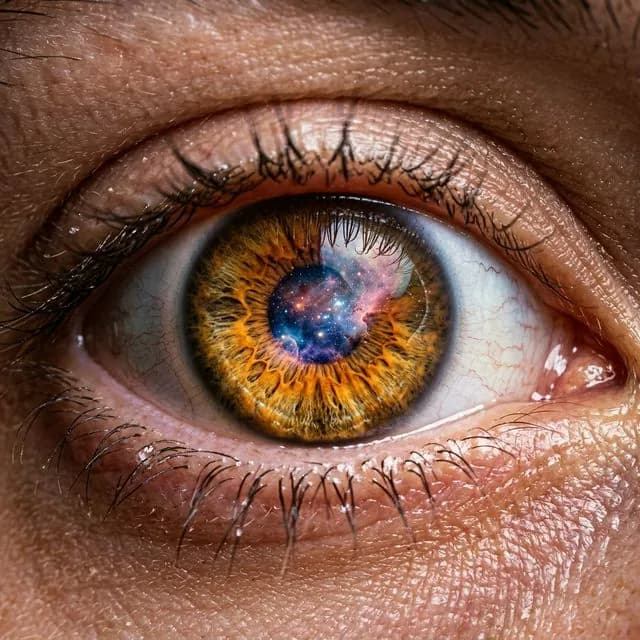
Hyper-Realistic Eye
AI prompt extraction analysis for Hyper-Realistic Eye
Extracted Prompt Formula
Hyper-realistic extreme close up of a human eye with amber irises, reflecting a vast cosmic nebula in the pupil, detailed skin pores and eyelashes, dramatic studio lighting.
Core Variables
- human eye
- amber irises
- cosmic nebula reflection
Detected Parameters
Ultra high definition, 8K, octane render quality lighting, microscopic details
About this AI Generated Image Prompt
One line here asks for something the optics will not give you. A nebula "reflecting in the pupil" puts an image in the single part of the eye that cannot hold one: the pupil is an aperture, a hole into a dark chamber, which is why it renders black. Reflections in eye photography live on the cornea, the wet convex dome sitting over the iris, and because that surface is convex it shrinks whatever it mirrors and wraps it around the curve. Asking for the pupil instead pushes the model toward an emissive pupil, a nebula glowing out of the eye rather than reflected into it. That can be the better image, but it is a different one, and the prompt should say which. The scale contrast is the transferable idea. Pores and individual lashes are mundane, and that is precisely their job: they establish a baseline of physical truth so the one impossible element has something to violate. Surrealism collapses when everything is strange and works when a single element is wrong while the surrounding evidence stays scrupulously right. Amber irises help, fixing a warm base that whatever cosmic colour arrives will read against, and the radial fibre structure of an amber iris supplies a small mandala of its own around the centre. "Dramatic studio lighting" is where control gets lost. In an eye macro the catchlight is not a detail, it is the signature: a ring light leaves an annulus, a softbox a soft-edged rectangle, a strip light a vertical bar. Whatever shape the model invents will be the first thing a viewer's eye lands on, and a wrong catchlight is the fastest tell that an image is synthetic. The prompt is silent on magnification too, which matters because near life-size reproduction the depth of field is well under a millimetre, so lashes, pores and iris fibres cannot all be sharp in one exposure without a small aperture or a focus stack. Adding "100mm macro, f/11, focus-stacked, single ring light producing a circular catchlight at eleven o'clock" fixes both gaps at once. Move the nebula from pupil to cornea and the physics becomes legible; or keep the glow deliberately, write "nebula emitting from within the pupil," and drop "reflecting" so the model stops trying to satisfy two incompatible descriptions of the same pixels.
Want to reverse-engineer a look like this from your own image? Try the free Image to Prompt tool to pull an editable prompt from any picture in seconds.
Want to extract prompts like this?
Try the AI Image DescriberRelated AI Prompts
Explore more extracted prompt formulas from our gallery.

Isometric Micro World
Octane render, global illumination, raytraced reflections, high poly
Lo-Fi Study Aesthetic
Warm color grading, relaxed atmosphere, detailed room environment

Low Poly Mountain River
Low polygon 3D art, flat shading, soft pastel sunset lighting