Cozy Autumn Study: Warm Golden Hour Glow
AI prompt extraction analysis for Cozy Autumn Study: Warm Golden Hour Glow
Extracted Prompt Formula
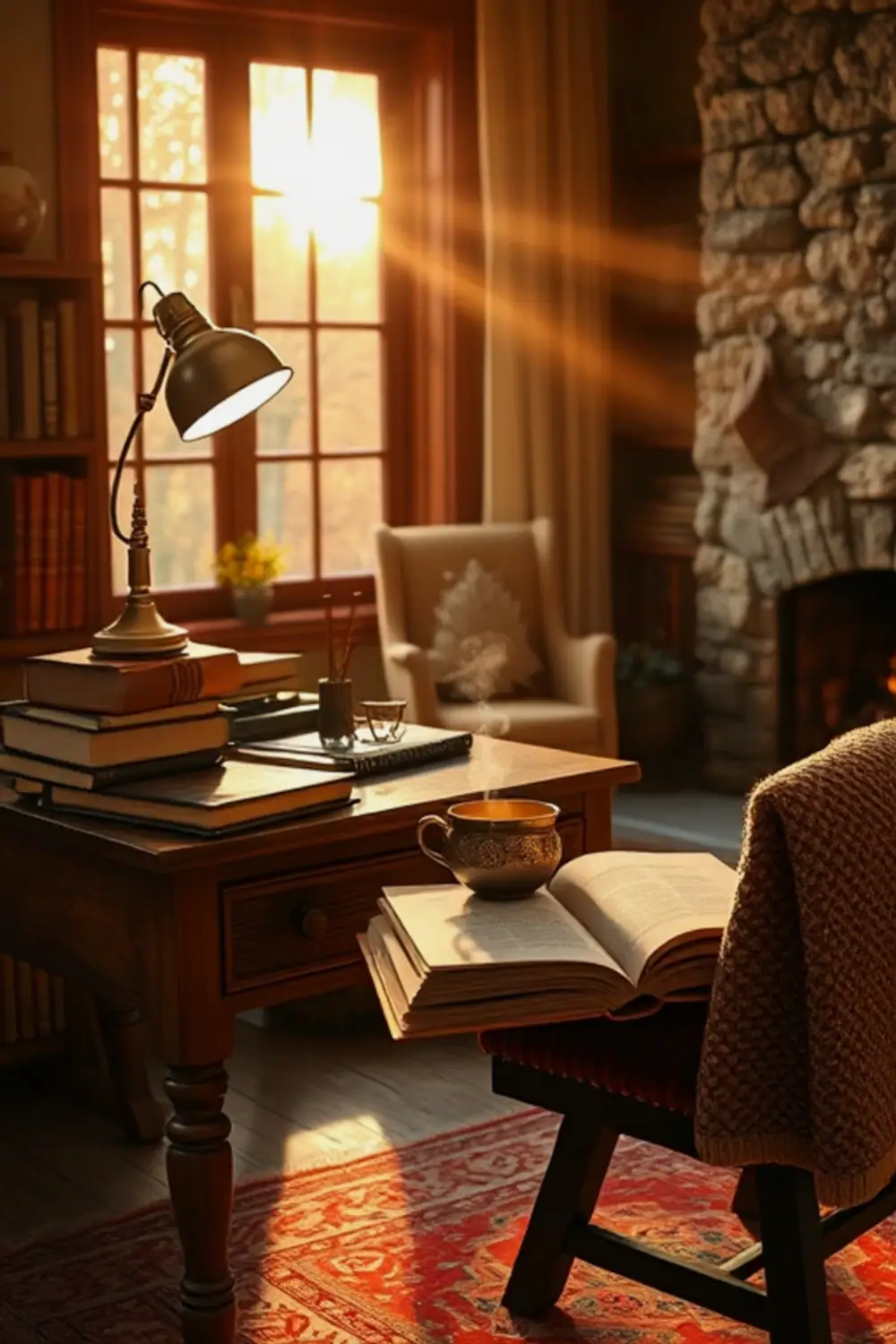
A cozy autumn study bathed in warm golden hour light, featuring a rustic wooden desk cluttered with leather-bound books, an antique brass desk lamp casting a soft amber pool, a steaming porcelain teacup with a cinnamon stick, and a window revealing a misty forest of crimson and orange leaves. The scene includes a vintage armchair with a knitted blanket, a crackling stone fireplace with glowing embers, and a Persian rug underfoot. Hyper-detailed textures: wood grain, paper fibers, wool, and brass patina. Volumetric light rays piercing through dust motes, with a shallow depth of field (f/1.4) focusing on the teacup and book pages. Shot on a 50mm lens, low-angle perspective from the floor. Cinematic composition, award-winning photography, 8k resolution, Unreal Engine 5 and Octane render, ray tracing, photorealistic, warm ochre and burnt sienna color palette, hyper-realistic, trending on ArtStation and Pinterest. --ar 2:3
Core Variables
Detected Parameters
About this AI Generated Image Prompt
Three separate light sources are named here and none is declared the key: unplaced golden hour light bathing the whole room, a brass lamp casting an amber pool, and a stone fireplace glowing with embers. Diffusion models resolve that ambiguity by averaging it, which is why prompts built this way return a room that is uniformly warm rather than one with direction. The volumetric rays the prompt also wants depend on the opposite condition, since a shaft only exists where one bright, small source is partially blocked. The window is already in the scene, so giving the golden hour light a direction through it and demoting the lamp and fire to background practicals would get you visibly closer to the described look. The f/1.4 clause deserves the same scrutiny. At 50mm from floor level, f/1.4 leaves a focus zone a few centimetres deep, and the prompt explicitly assigns it to the teacup and the book pages. Everything else in that long inventory — the armchair, the knitted blanket, the Persian rug, the fireplace, the misty forest beyond the glass — is commissioned in hyper-detail and then discarded by the aperture. That is not automatically wrong, since shallow depth of field is what makes a cluttered desk read as intimate instead of chaotic, but it does mean most of the prop list is paying rent as coloured bokeh. If the fireplace is meant to be legible, either stop down or cut it. There is also an unresolved medium conflict. Award-winning photography and photorealistic pull toward lens behaviour, sensor grain and optical falloff; Unreal Engine 5, Octane, ray tracing and trending on ArtStation pull toward CG, where highlights are cleaner and surfaces slightly too perfect. The negative list then bans noise and grain, removing the last photographic tell, so the result usually lands on the render side of that line. Pick one vocabulary and the image sharpens. A large part of that negative list is also inert: bad anatomy, extra limbs, malformed hands and cloned face describe people in a room containing none, and boring, plain and soulless have no visual referent at all, which dilutes the weight carried by the terms that genuinely work here — modern, sterile, fluorescent. The change I would make: swap the aperture clause for f/4 with focus on the open book, teacup slightly forward and soft. The intimacy survives, but the fireplace and the window regain enough definition to establish the room the rest of the prompt describes.
Want to reverse-engineer a look like this from your own image? Try the free Image to Prompt tool to pull an editable prompt from any picture in seconds.
Want to extract prompts like this?
Try the AI Image DescriberRelated AI Prompts
Explore more extracted prompt formulas from our gallery.