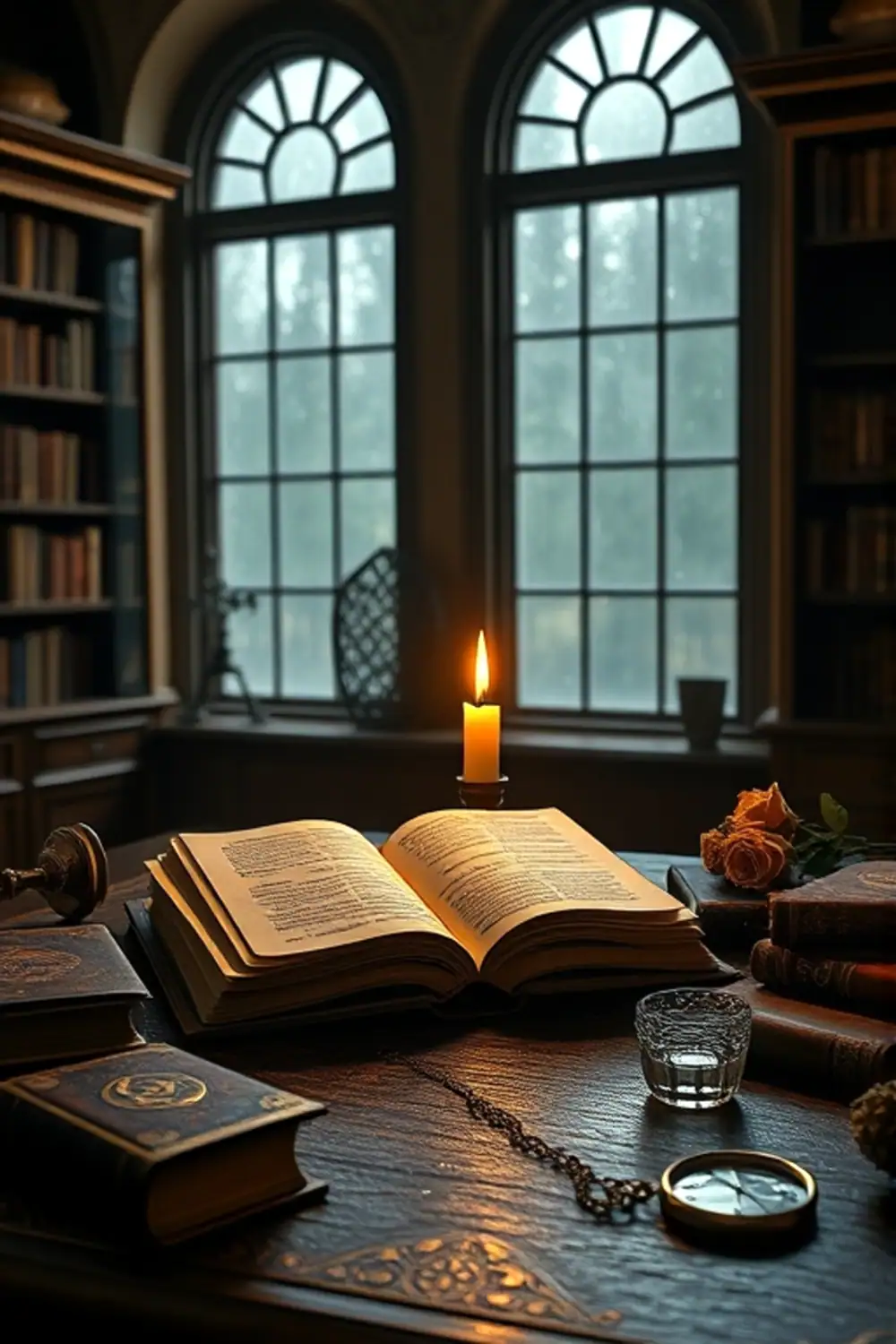
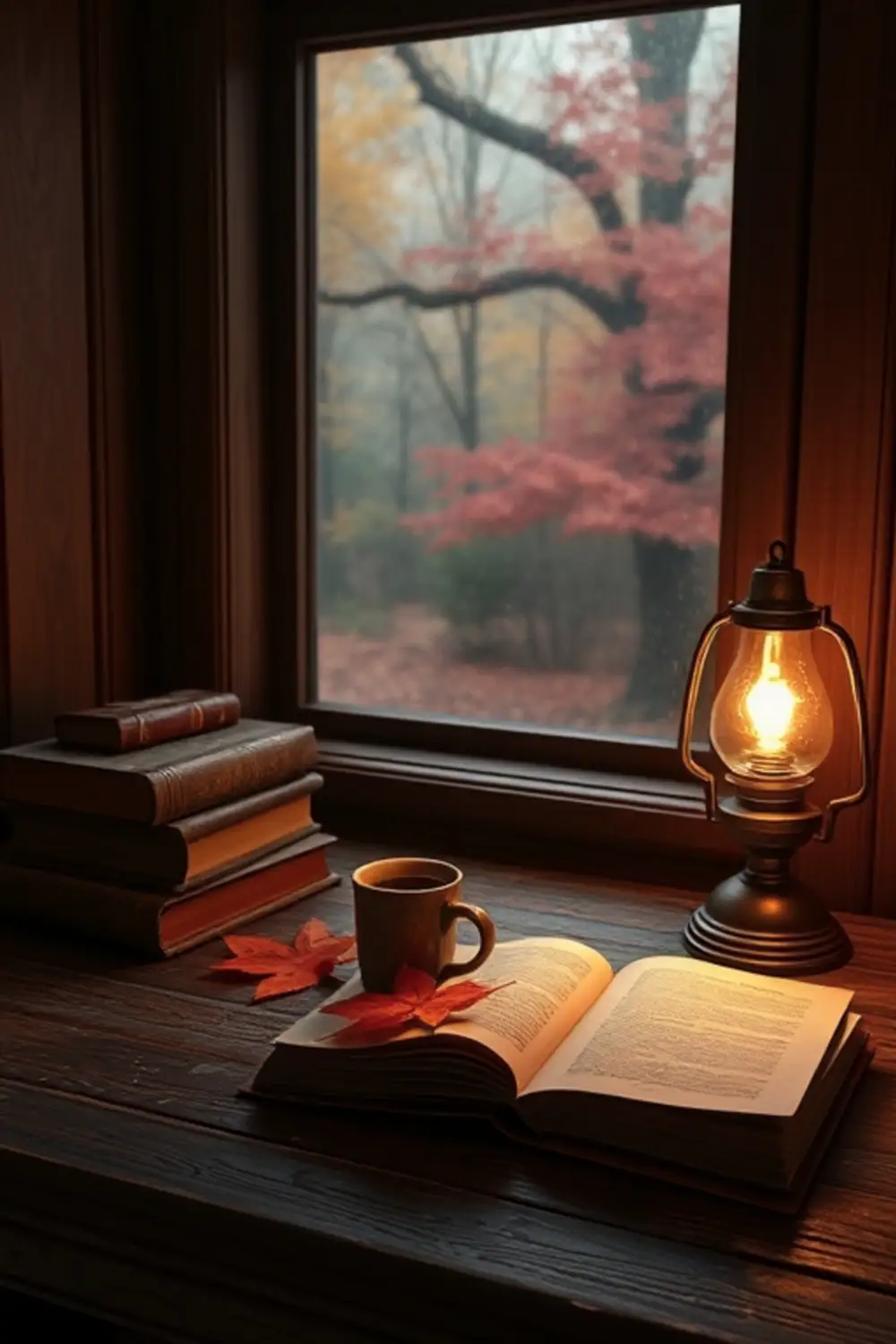
Vintage Library Mood Board: Cozy Gothic Glow
AI prompt extraction analysis for Vintage Library Mood Board: Cozy Gothic Glow
Extracted Prompt Formula
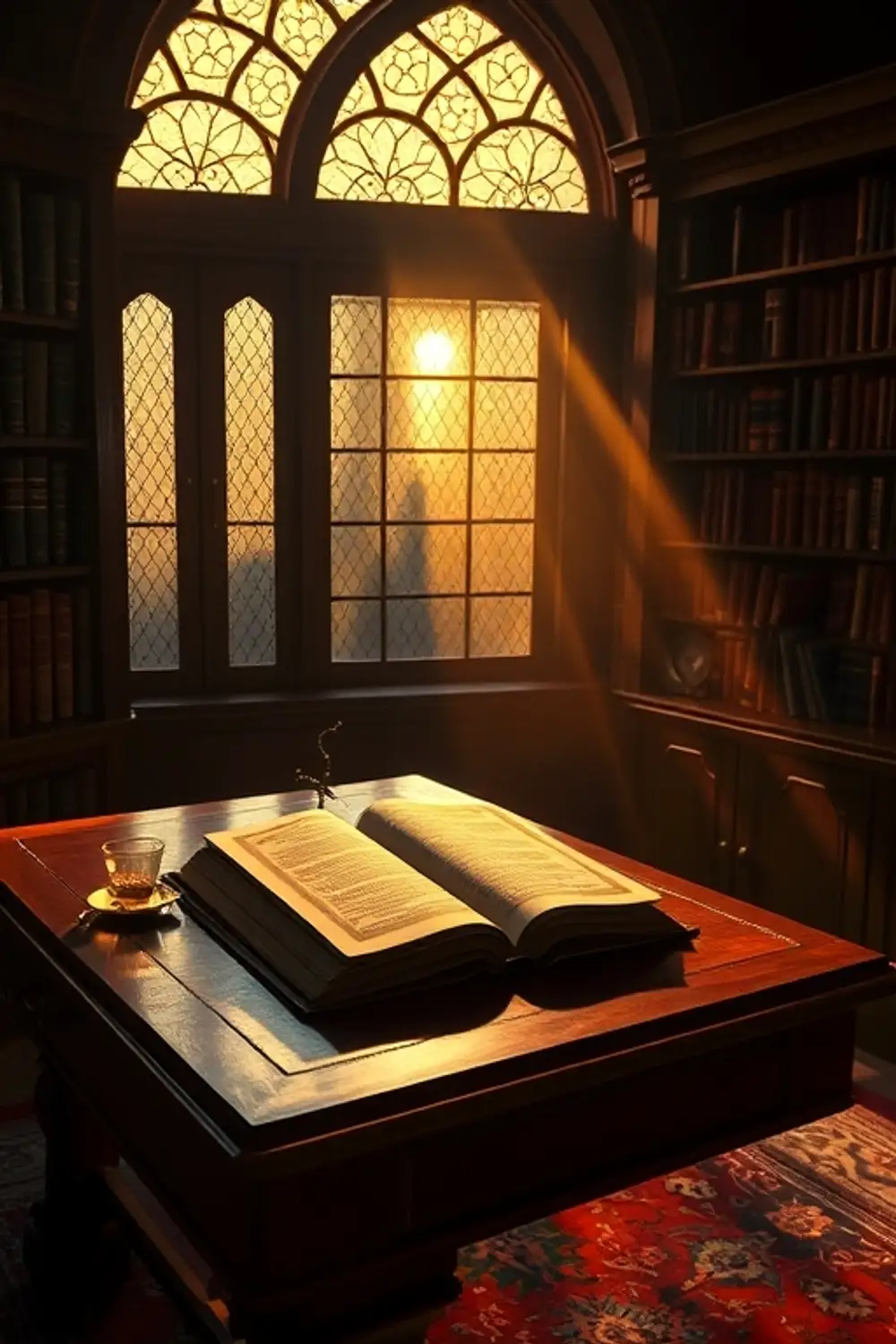
A moody, vintage library interior bathed in warm, volumetric golden hour light streaming through an arched leaded glass window, casting intricate geometric shadows across a polished mahogany desk. On the desk, an open antique leather-bound book with gilded edges rests beside a brass magnifying glass and a half-empty crystal inkwell, its surface catching a single glint of light. A forgotten cup of tea emits a delicate wisp of steam. The shelves are filled with weathered books in faded maroon, forest green, and navy blue, their spines cracked with age. A worn Persian rug in deep burgundy and indigo anchors the scene. The atmosphere is silent, scholarly, and slightly gothic, with dust motes dancing in the light beam. Shot on a medium format camera with a 50mm lens, f/1.4 aperture, shallow depth of field focused on the open book, cinematic composition, award-winning photography, hyper-detailed textures, 8k resolution, Unreal Engine 5 rendering, octane render, ray tracing, volumetric lighting, soft film grain, dark academia aesthetic --ar 2:3
Core Variables
Detected Parameters
About this AI Generated Image Prompt
Leaded glass is the real light-shaping tool in this version, and it is what separates the frame from every other dark-academia library. Plain window light behaves like a softbox: broad, even, shadowless at its edges. Leaded glass breaks that same beam into a grid, because the lead cames between panes are opaque strips that carve the light before it lands. The prompt names the consequence directly, 'intricate geometric shadows across a polished mahogany desk', and that pattern falling on reflective wood is what gives the picture structure. Volumetric light and dust motes then make the beam visible in the air, so the shape appears twice, once travelling and once landed. The camera specification, though, describes a lens that does not exist. No body is named, only 'medium format', which leaves even the sensor open: on the 44x33mm sensor of a modern digital back a 50mm is a wide-angle, near a 40mm equivalent, and on 645 film it is wider still. The second problem is the aperture, since no medium-format standard lens opens anywhere close to f/1.4, the fast end of those systems sitting around f/1.9. What the prompt actually describes is the rendering of a full-frame fast fifty: tight focus, steep fall-off, a compressed slice of sharpness on the gilded page edge. Requesting it under a medium-format label pulls toward two looks at once. Pick one. 'Full frame, 50mm at f/1.4' buys the razor-thin focus; 'medium format, 80mm at f/2.8' buys the larger-sensor tonality with the whole desk arrangement still intelligible. The negative list carries a related misunderstanding in 'dust motes too large'. Negative prompts operate on concepts, not magnitudes, and there is no mechanism for suppressing a size. Scale belongs in the positive text, as 'fine, sparse dust suspended in the beam'. In the same spirit, 'Unreal Engine 5 rendering, octane render, ray tracing' sits awkwardly beside 'award-winning photography' and 'soft film grain', since engine tokens pull toward clean synthetic surfaces, which is the plastic look the negative prompt is separately trying to ban. For a variant, keep the window and change the hour: 'overcast north light, no direct beam, the leaded pattern reduced to faint tonal shifts across the desk'. All the shadow drama disappears and the image has to survive on texture, colour and the inkwell's single glint, which is a fast way to measure how much of this composition was carried by one window.
Want to reverse-engineer a look like this from your own image? Try the free Image to Prompt tool to pull an editable prompt from any picture in seconds.
Want to extract prompts like this?
Try the AI Image DescriberRelated AI Prompts
Explore more extracted prompt formulas from our gallery.