Gamer Room Diorama
AI prompt extraction analysis for Gamer Room Diorama
Extracted Prompt Formula
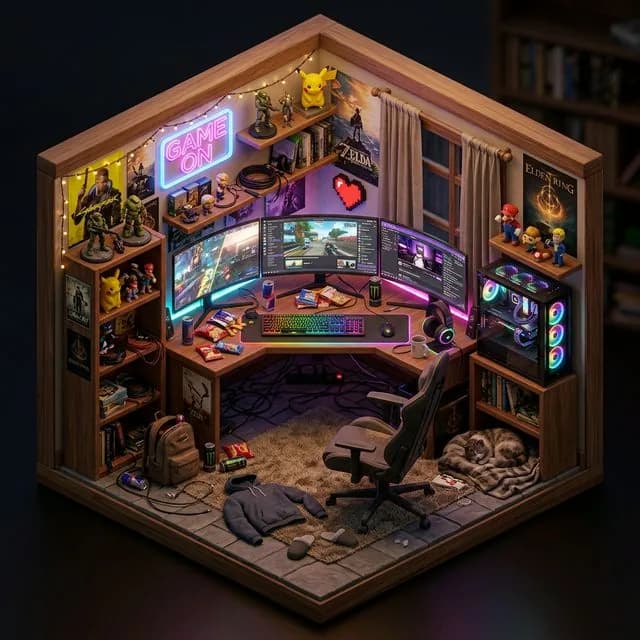
Tiny high-poly isometric 3D diorama of a messy cozy gamer room, glowing RGB neon lights, multiple curved monitors, mechanical keyboard, intricate details, soft global illumination.
Core Variables
- cozy gamer room diorama
- glowing RGB neon lights
- curved monitors
Detected Parameters
Micro-detailed diorama, soft shadows, warm and cool light balance
About this AI Generated Image Prompt
Isometric is a strict projection, not a mood. Parallel lines stay parallel, there is no vanishing point, and the three axes are equally foreshortened. Generative models rarely honour that literally; what usually comes back is a slight three-quarter perspective that reads as isometric because the camera is high and the object is small and centred. That is worth knowing, because if the parallel look actually matters — for a game asset sheet, say — adding orthographic, no perspective distortion does far more than trusting the single word. The real tension sits between glowing RGB neon lights and soft global illumination, which want opposite things. Global illumination describes light bouncing between surfaces until shadows fill in and contrast drops. RGB strips are saturated coloured emitters whose entire appeal is the hard separation between one wall and the next. Push the bounce and those colours average into a uniform wash; keep them distinct and the room needs a darker ambient than soft implies. The fix is to name the emitters and let the bounce work from there — one strip behind the monitors, a second under the desk, nothing else lit. Then the global illumination carries two colours rather than blending twelve into mud. Messy and intricate details also stack in the same direction without telling the model what the mess consists of. Curved monitors and a mechanical keyboard are the only named objects, so the remaining volume fills with whatever the model associates with a gamer room: energy drink cans, a headset, a tower, a racing chair. That is why diorama prompts of this type converge on nearly identical furniture. Naming three specific pieces of clutter, however mundane, replaces the model's defaults with yours. High-poly is worth keeping in that same spirit, since it is the one term steering geometry rather than atmosphere. And since DALL-E 3 ignores negative fields, anything you want absent has to be written as what occupies that space instead. A concrete adaptation: put the room inside a cut-away cube on a plain neutral backdrop with one wall removed. The diorama framing survives, but the model now has an explicit boundary to compose against, the RGB spill escapes past the missing wall and finally reads as coloured light rather than coloured objects, and the isometric impression strengthens considerably because the cube's edges expose three visible parallel axes.
Want to reverse-engineer a look like this from your own image? Try the free Image to Prompt tool to pull an editable prompt from any picture in seconds.
Want to extract prompts like this?
Try the AI Image DescriberRelated AI Prompts
Explore more extracted prompt formulas from our gallery.

Dynamic Sword Clash
High speed action anime, heavy contrast ink lines, dramatic focus

Ethereal Forest Scenic
Soft natural lighting, macro details, deep depth of field, vibrant greens

Fluffy 3D Character
Volumetric hair grooming, soft studio lighting, adorable proportions