Cozy Autumn Study: Vintage Inkwell Glow
AI prompt extraction analysis for Cozy Autumn Study: Vintage Inkwell Glow
Extracted Prompt Formula
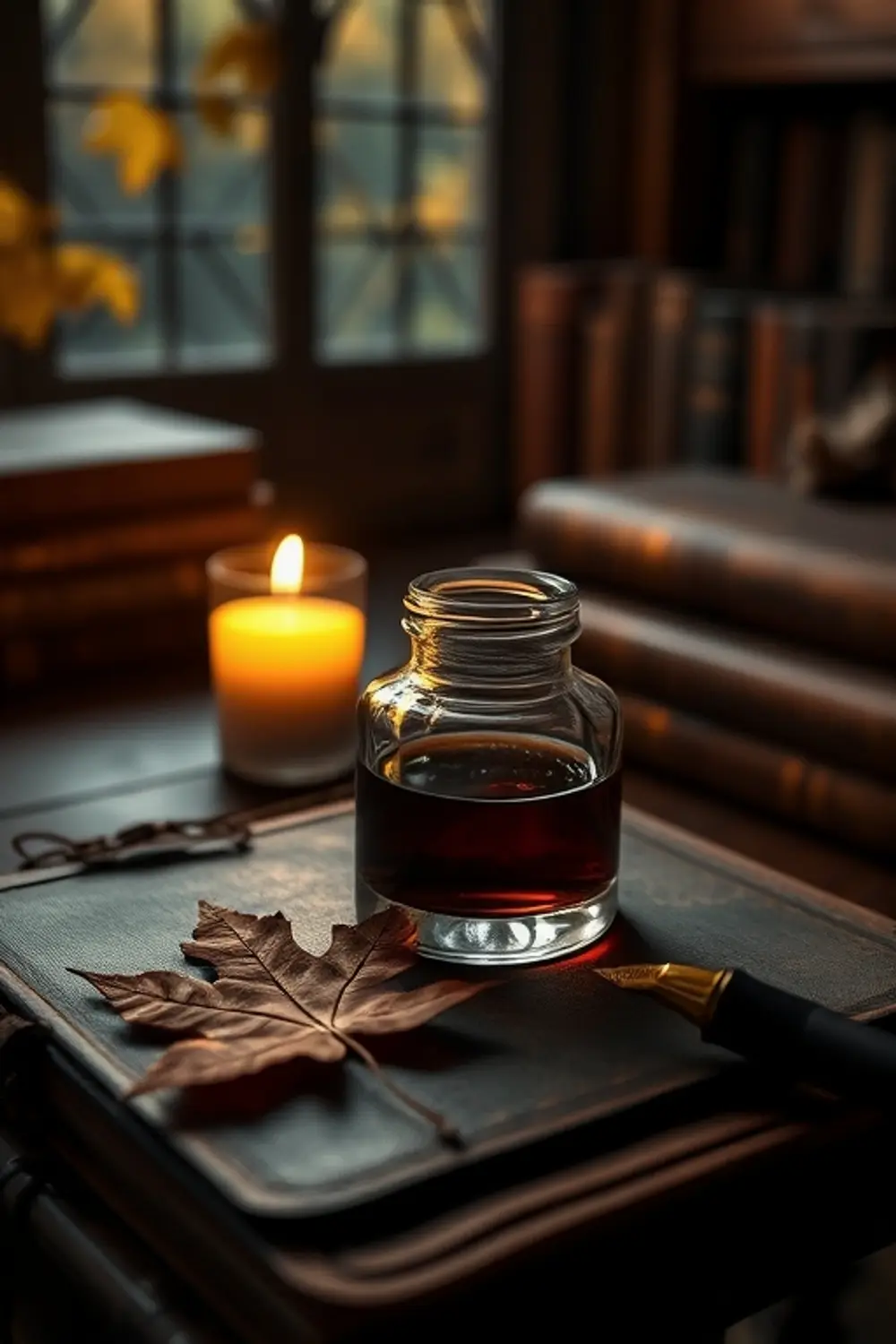
A hyper-detailed, award-winning macro photography shot of a vintage glass inkwell on a dark mahogany writing desk, the ink a deep sepia tone. A single, long-burning beeswax candle provides the sole light source, casting dramatic chiaroscuro and long, sharp shadows across a worn leather journal and a fountain pen with a gold nib. The scene is thick with the mood of a late autumn evening; a single, dried maple leaf lies beside the inkwell. The background is a blur of aged, leather-bound books and the faint, ethereal glow of a rain-streaked leaded glass window, with falling yellow leaves visible outside. Volumetric candlelight illuminates dust motes dancing in the air. Shot with a macro lens at f/1.4, achieving a shallow depth of field that isolates the inkwell in perfect sharpness. Rendered in 8k, cinematic, hyperrealistic detail using Unreal Engine 5 and Octane render, with a warm, low-key color palette of burnt umber, gold, and black. The texture of the wood grain, the paper's fiber, and the glass's patina are all exquisitely defined. Cozy autumn study inspiration, vintage aesthetic, dark academia mood board --ar 2:3
Core Variables
Detected Parameters
About this AI Generated Image Prompt
One flame, declared as the sole light source, is the strongest decision in this prompt and the reason the scene holds together. A single small source falls off with the square of distance, so the inkwell sits bright, the journal a stop or two down, and the blurred books behind sink to near-black, broken only by the faint window glow the prompt allows them. That is where the chiaroscuro comes from, and it is why the dust motes are plausible, since airborne particles only show when a source sits beside or behind them against an unlit background. Every element in the frame inherits its exposure from that one candle. The macro specification undercuts it. Depth of field collapses as magnification rises, so at true macro distances f/1.4 leaves a plane of focus measured in fractions of a millimetre. The near rim of the glass would be sharp and the far rim already gone, which is the opposite of holding the inkwell in perfect sharpness. Fast macro lenses barely exist for this reason; most sit at f/2.8, and real macro work stops down to f/8 or beyond and stacks several frames. Asking for f/5.6 with focus stacking describes something achievable while still isolating the subject against a soft background. The two halves also contradict each other directly. The positive asks for Unreal Engine 5 and Octane render; the negative bans 3d render and plastic. That is the same quality arriving from both directions, and the engine tags are precisely what push glass and wax toward the smooth synthetic surface the negative is trying to prevent. Since the prompt opens by calling itself macro photography, the engine names are the part to cut. Separately, the trailing aspect flag is Midjourney parameter syntax, and Flux takes explicit dimensions, so it is either ignored or absorbed as stray text; set 832 by 1248 in the interface instead. Try replacing the render-engine tags with an exposure: 1/15s at f/5.6, ISO 3200, tripod. Naming a real low-light capture brings back the faint sensor noise and the deep falloff that make candlelit photographs read as photographs, whereas Octane and Unreal push toward a clean, noiseless surface with no grain anywhere, which is the tell that gives away most award-winning photography prompts.
Want to reverse-engineer a look like this from your own image? Try the free Image to Prompt tool to pull an editable prompt from any picture in seconds.
Want to extract prompts like this?
Try the AI Image DescriberRelated AI Prompts
Explore more extracted prompt formulas from our gallery.